
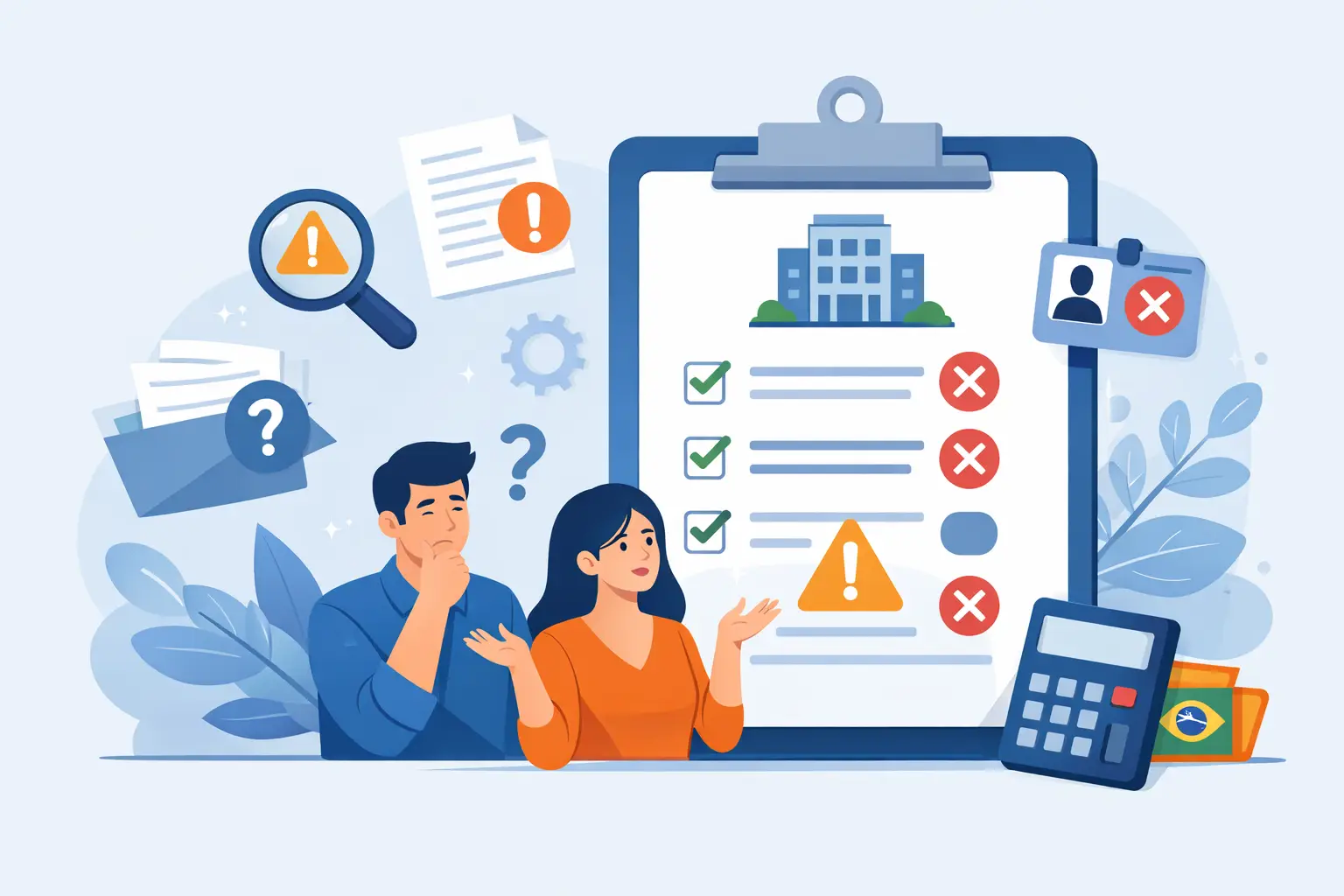
In high-volume operations, the problem rarely begins with a sophisticated fraud. In practice, many deviations are born from simple entry failures, insufficient validation or excessive trust in the typed data. When we talk about common mistakes in CNPJ registration, the impact goes beyond an incorrect record: it shows up in onboarding failures, rejected fiscal issuance, imprecise risk analysis and operational rework.
For product, risk, compliance and engineering teams, this topic is not just about registration. It is a critical layer of KYB, fraud prevention and transactional consistency. And there is a point that is usually underestimated: validating the format is not the same as validating existence, activity and adherence of the data to the official record.
Where common mistakes in CNPJ registration cost the most
The cost of an incorrect registration is not always immediate. In many flows, the record enters, the operation proceeds and the problem only appears later, when there is invoice issuance, payment, credit release, internal audit or regulatory review. This increases the cost of correction because the error stops being a one-off adjustment and starts to contaminate subsequent stages.
In segments such as fintech, marketplace, health, logistics, crypto and iGaming, the CNPJ is often a central identifier for the commercial relationship. If it enters wrong, outdated or disconnected from the official database, the company loses visibility over who is being enabled in the operation. In a more critical scenario, a document that looks valid in the check digit may be nonexistent, unfit or linked to a corporate name different from the one informed.
1. Validating only the check digit
This is one of the most frequent and also one of the most expensive mistakes. Mathematical validation via the mod-11 algorithm is necessary, but insufficient. It only confirms that the numerical structure of the CNPJ makes sense. It does not confirm whether the document exists at Receita Federal, whether it is active or whether it belongs to the declared company.
In practical terms, this means accepting as reliable a formally valid number that is operationally useless or risky. For a B2B registration flow, this difference matters a lot. The data needs to pass through two layers: integrity of the number and official verification of registration existence.
2. Ignoring divergence between CNPJ and corporate name
Another recurring mistake is capturing the CNPJ in one field and the corporate name in another, without checking adherence between them. When this cross-check does not happen, two bad possibilities open up: operational error from typing or a deliberate attempt to mask corporate identity.
In more sensitive risk operations, it is not enough to know that the CNPJ exists. It is necessary to verify whether it corresponds to the company being registered. A divergence between the number and the corporate name affects due diligence, harms auditing and can compromise internal approval rules, especially for partners, sellers, establishments or business accounts.
3. Accepting outdated address and registration status data
Some companies validate the CNPJ only once and start to trust this snapshot for an indefinite time. This model works poorly in dynamic environments. Registration status changes. Address changes. The business name can change. And a decision made based on old data can generate an improper block or, worse, an improper approval.
For continuous registration operations, the ideal is to work with an updated query against an official source. Daily updates make a difference because they reduce the window between the registration change and the operational decision. In compliance and antifraud, this interval matters.
4. Not handling headquarters and branch correctly
Much inconsistency arises from the incorrect reading of the CNPJ structure. In some flows, the company informs a branch CNPJ, but the team expects headquarters data. In others, the headquarters is registered, but the real operation occurs through a distinct unit. Without adequate handling, problems arise in billing, eligibility, commercial analysis and traceability.
The point here is not to define that the headquarters is always better than the branch. It depends on the use case. For a contract, fiscal issuance, accreditation or risk analysis, the correct unit can vary. The mistake is not modeling this distinction from the start of the flow.
When headquarters and branch require different rules
If your operation makes financial transfers, invoice issuance or regional accreditation, it is advisable to apply specific rules for each type of establishment. This prevents a valid CNPJ, but inadequate for that purpose, from being accepted automatically.
5. Allowing manual registration without data normalization
The larger the volume, the greater the cumulative effect of small deviations. A field with an inconsistent mask, special characters, extra spaces, different abbreviations and free fill-in of the corporate name seem like details, but they hinder matching, deduplication and subsequent checking.
Normalization does not solve everything, but it eliminates unnecessary noise. The registration needs to handle the CNPJ in a standardized way, sanitize text fields and organize the data for reliable comparison. Without this, the number of false negatives in validation increases, as does the volume of manual review.
6. Not blocking an incompatible registration status
There are flows that query the registration status but do nothing with the response. The data becomes just an on-screen record, with no associated operational rule. This is a process design error, not just a technology one.
If a CNPJ is unfit, closed, suspended or in a condition incompatible with the type of relationship, the system needs to react. In some cases, the correct action is automatic blocking. In others, manual review or a request for additional documentation. The criterion depends on the risk appetite, but the absence of a criterion usually turns out more expensive.
7. Leaving validation until after onboarding
In pursuit of conversion, many companies push registration checking to a later stage. The reasoning seems simple: reduce friction at entry and validate later. The problem is that this "later" frequently happens when there has already been operational cost, exposure to fraud or improper activation.
Not every flow requires the same depth in the first stage. This is true. But completely delaying CNPJ validation usually transfers risk to more sensitive phases of the process. A better approach is to calibrate the depth of the check according to the moment of the journey and the type of operation being released.
What to validate in real time
At a minimum, it is worth confirming the structure of the document, its existence in the official database, the registration status and the adherence to the informed corporate name. If the flow involves billing, a contract or credit analysis, the address also starts to carry greater weight.
8. Relying on manual queries without an audit trail
Spreadsheets, ad hoc searches and human checking can work at very low volume. Beyond that, they become a bottleneck. In addition to slowness, there is a governance problem: without a structured trail, the company loses evidence of when it queried, what response it received and what decision it made based on that data.
In regulated sectors or those exposed to chargeback, documentary fraud and inspection, this is especially sensitive. Automation does not only serve to gain speed. It serves to standardize decisions, reduce human error and maintain a verifiable history.
How to reduce common mistakes in CNPJ registration in practice
The correction starts with the validation architecture, not with isolated team training. Training operators helps, but it does not eliminate a structural failure. What works better is combining entry rules, algorithmic validation, official query and automated handling of the response.
In a mature flow, the system captures the CNPJ, sanitizes the value, validates the check digits and queries the official database to return the registration status and associated data. From there, business rules decide whether the registration proceeds, requires review or should be blocked. This design reduces subjectivity and creates scale.
It is also worth observing the response time and stability of the infrastructure. If the validation takes too long, the product area tends to relax the check to protect conversion. If availability is inconsistent, the operation starts to create manual exceptions. For this reason, performance and reliability are not isolated technical details. They determine whether the validation will indeed occupy a central position in onboarding.
For companies that operate with volume, a layer of real-time query with updated official D+0 data helps reduce this friction without giving up control. It is at this point that solutions such as CPF.CNPJ fit well: not just as a document query, but as a validation infrastructure for KYB, compliance and fiscal issuance flows.
What changes when registration stops being just a form
When business registration is treated as a decision infrastructure, the gain appears on several fronts at the same time. The risk team improves the quality of triage. Compliance gains traceability. Operations reduce rework. Engineering stops sustaining manual exceptions. And product manages to balance conversion with security in a more predictable way.
The central point is simple: the CNPJ should not be a passive field. It should be a verified, contextualized and actionable piece of data within the flow. Those who get this layer right early prevent small errors from turning into financial loss, fiscal inconsistency and regulatory exposure later on.
If your onboarding still depends on superficial validations or scattered queries, it is worth reviewing the design now. Correcting this at registration costs less than remedying the problem once it has already entered the operation.