
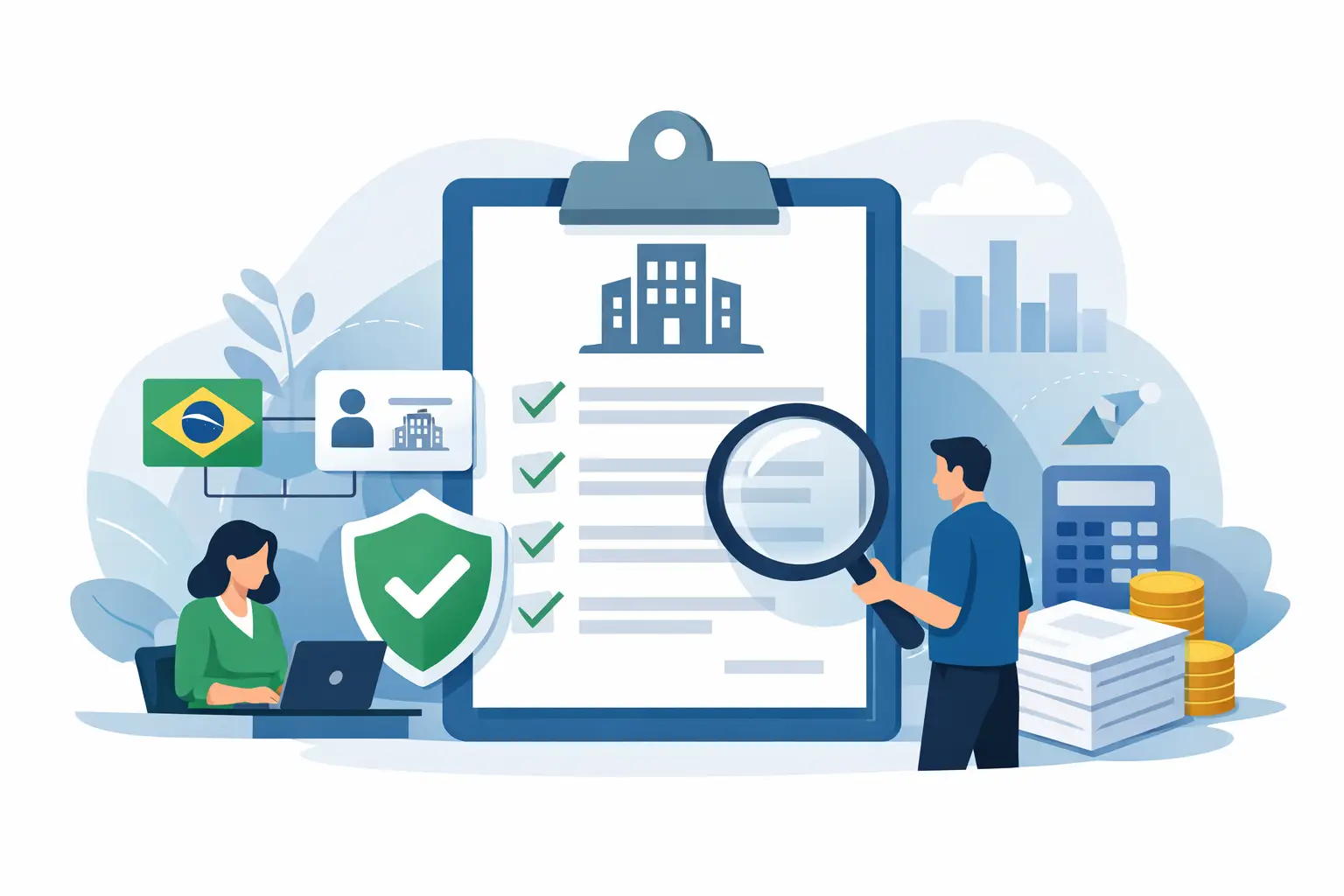
Issuing an invoice for an invalid, closed CNPJ or one with divergent data usually shows up too late in the flow - when billing stalls, reconciliation breaks or the tax team has to fix the registration at the last minute. For operations with volume, understanding how to validate CNPJ for billing is not an operational detail. It is a control step that reduces rework, fiscal risk and exposure to fraud.
Correct validation goes beyond checking whether the number “looks right.” A CNPJ can pass the check-digit calculation and still be unfit for your process context. That is why more mature companies handle validation in two layers: the document's mathematical consistency and the lookup of the registration status against an official database.
What it really means to validate a CNPJ
In many flows, “validating CNPJ” is still used as a synonym for applying the check-digit algorithm, mod-11. This test is useful, but it only solves part of the problem. It confirms that the structure of the number is coherent, not that the company exists, is active or has registration data compatible with billing.
In practice, for tax issuance and B2B onboarding, validation needs to answer at least four questions. Is the CNPJ mathematically valid? Does it exist at the Receita Federal? Does the registration status allow operating safely? Does the associated data, such as legal name and address, match what was provided in the registration?
When this second layer does not exist, the process becomes vulnerable to manual error, registration fraud and inconsistency between the commercial, financial and tax systems.
How to validate CNPJ for billing the right way
If the goal is to bill safely, the ideal flow starts at registration and continues before the invoice is issued. First, validate the document's structure to eliminate typos and invalid entries right at the source. Then, query the official database to verify existence, registration status and the data linked to the CNPJ.
This point is decisive because billing depends on reliable data. A divergent legal name, an outdated address or a CNPJ with an irregular status can generate an operational rejection, failures in tax integrations and the need for reprocessing. In high-volume companies, the cost lies not only in the rejected invoice. It lies in the team's time, the delay in revenue and the increase in the risk of exceptions.
Digit validation is not enough
Mod-11 is a first technical barrier. It helps avoid malformed documents and reduces simple input errors. But it does not detect whether the CNPJ has been closed, suspended, made unfit or whether it belongs to a company with data different from what the customer declared.
For billing, this makes a direct difference. A registration may enter the CRM “clean,” move forward to commercial approval and only fail when it reaches the tax layer. In this scenario, the problem did not start at invoice issuance. It started when the operation accepted a document without official validation.
The official lookup is the operational security layer
By querying up-to-date official data, the company can confirm the registration status and capture a registration summary useful for checking. This includes the business name, address and other data relevant to validating the legal identity and the consistency of the registration.
For risk, compliance and operations teams, this return makes it possible to automate rules. A simple example: block billing for CNPJs with an irregular status. A more mature example: cross-check the legal name and address against the provided registration and send only the exceptions to manual analysis.
Where companies most often go wrong in this process
The most common mistake is validating late. When the CNPJ is only checked at the final stage, the operation has already consumed commercial effort, credit, support or logistics on a registration that perhaps should not even have been approved.
The second mistake is relying only on spreadsheets, manual lookups or one-off checks. This may work at low volume, but it does not scale with predictability. Beyond being slow, the manual process creates windows for inconsistency and makes traceability difficult.
The third mistake is treating all flows the same way. Not every case requires the same depth of validation. A marketplace, a fintech and a healthcare operation have different risk requirements, but all need a minimum criterion: a valid document, confirmed existence and coherent data to bill.
When to validate in the registration and billing flow
The best moment depends on the design of the operation, but there is an efficient pattern. The first validation should happen at the entry of the registration, to filter out error and fraud as early as possible. Then, it is worth repeating the lookup at critical points, such as account approval, limit release or tax issuance.
This matters because the registration status can change. A company that is active today may not be in the same condition tomorrow. In recurring operations or those with a high ticket, working with an up-to-date lookup reduces the risk of billing based on aged information.
For digital businesses, automation via API tends to be the most consistent path. It makes it possible to validate in real time, integrate the response into the product flow and record evidence of the lookup for audit and compliance.
How to implement validation without increasing friction
There is an important balance here. If validation is too strict on the interface and slow on the backend, onboarding loses conversion. If it is too loose, the risk rises and the problem appears later. The right design depends on your volume, the regulatory criticality and the cost of fraud or tax rework.
In practice, a good implementation separates automatic response from exception analysis. Clearly valid cases proceed without friction. Cases with objective divergence go into review. This preserves operational performance without giving up control.
It also helps to work with predictable response times and simple integration. In transactional operations, validation needs to fit into the normal flow of the system. If it adds excessive complexity for engineering, the tendency is for it to become an optional step - and an optional step rarely protects a critical process.
What to evaluate in a validation solution
If CNPJ validation is going to support billing, onboarding or KYB, some criteria are practical. The first is the origin and update of the data. A lookup with an official database and D+0 updates reduces the chance of deciding based on outdated information.
The second is coverage. It is no use for the solution to work well in a demo and fail when the volume grows or when the operation needs to query any document received. The third is performance, because a slow response affects product and operation. The fourth is availability, especially when validation sits on the critical path of issuance and approval.
Finally, look at integration. A JSON API, simple token authentication and adoption without implementation cost speed up the rollout and reduce internal dependency. For many companies, this point weighs as much as the price per lookup, because the ROI comes from the combination of less fraud, less rework and lower operational effort.
In this context, platforms like CPF.CNPJ make sense when the operation needs to combine check-digit validation with an official lookup, a registration-summary return and performance compatible with production use.
How to validate CNPJ for billing at scale
At high volume, validating well means turning the lookup into an operational rule. The CNPJ enters the system, the application checks the structure, queries the official database, returns the registration status and compares key data with the provided registration. From there, the flow itself decides whether to approve, block or route for review.
This model reduces dependence on manual checking and creates a standard. It also improves traceability, because each decision now has an objective basis recorded at the moment of analysis. For compliance and audit, this is better than depending on screenshots, ad hoc lookups or validations done outside the system.
There is, of course, a trade-off. Not every divergence requires a total block. In some segments, it makes sense to allow continuity with a caveat and a later review. In others, such as operations more exposed to fraud or regulatory requirements, the automatic block is the safest choice. The point is not to adopt the strictest rule. It is to adopt a rule coherent with your business's risk.
The direct impact on billing and risk
When validation is well implemented, the gain appears on several fronts at the same time. The tax team loses less time on registration corrections. Commercial operations bill with fewer exceptions. Risk and compliance can act before the problem materializes. And engineering stops maintaining patches for data that should never have entered the system.
This kind of control also improves the quality of the database. Over time, the company reduces duplication, inconsistency and low-reliability registration. The effect is cumulative: less error at the source means less cost in all the following steps.
Validating CNPJ for billing, therefore, is not an isolated check. It is an infrastructure layer to operate safely, automate decisions and sustain scale without losing control. If your process still depends on manual checking or validates only the check digit, the bottleneck is already designed - it just has not appeared at the worst moment yet.